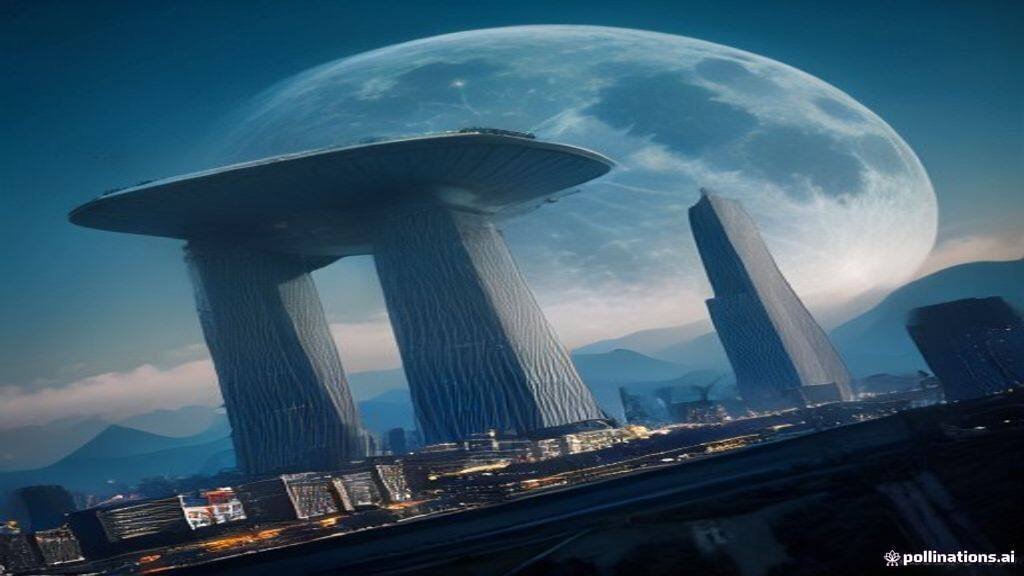
The dawn of the 21st century sparked a new space race, but unlike the Cold War era, this iteration is driven by private enterprise and the promise of permanent lunar habitation. As nations and corporations pivot their focus toward establishing a “Moon City,” the complexities of off-world infrastructure are beginning to surface. Simultaneously, back on Earth, our skies are becoming increasingly congested with autonomous aerial vehicles, necessitating a revolution in drone traffic management. At the intersection of these two frontiers lies a common denominator: the urgent need for sophisticated, AI-driven governance systems capable of managing environments where human reaction times are simply insufficient.
The Architectural Nightmares of Lunar Colonization
Establishing a permanent presence on the Moon is not merely a logistical challenge; it is an architectural and engineering gauntlet. Unlike Earth, where the environment provides breathable air, stable temperatures, and radiation shielding, the Moon is a hostile vacuum. The primary problem facing prospective “Moon City” planners is the lunar regolith—a jagged, electrostatic dust that clings to everything. This dust is abrasive enough to destroy seals, clog mechanical joints, and interfere with sensitive electronic sensors. AI researchers are currently developing robotic systems that can autonomously detect and mitigate dust accumulation, but the challenge extends far beyond maintenance.
Urban planning on the Moon requires a radical departure from terrestrial design. Because the lunar surface is constantly bombarded by micrometeoroids and solar radiation, the most viable “cities” will likely be located underground or within existing lava tubes. These subterranean environments create massive communication bottlenecks. Managing the flow of oxygen, water, and power through a maze of pressurized tunnels requires a centralized, intelligent nervous system. AI-governed utility grids are being designed to predict consumption patterns and instantly isolate sectors in the event of a breach, ensuring that a single structural failure does not jeopardize the entire colony. The autonomy of these systems is non-negotiable, as the three-second communication delay between Earth and the Moon makes real-time remote control from mission control centers impossible for emergency situations.
The Traffic Control Crisis in Our Skies
While we contemplate the logistics of lunar living, a more immediate crisis is unfolding in the low-altitude airspace above our major cities. The rapid proliferation of delivery drones, inspection craft, and urban air mobility (UAM) vehicles has pushed current air traffic control (ATC) paradigms to their breaking point. Traditional ATC systems, which rely on human controllers monitoring radar screens and communicating via radio, were designed for a handful of commercial jets at high altitudes, not thousands of autonomous drones navigating the “urban canyons” of a modern metropolis.
The solution currently being piloted is Unmanned Aircraft System Traffic Management (UTM). Unlike traditional systems, UTM is almost entirely automated. It utilizes AI to create a dynamic, four-dimensional map of the sky. By integrating real-time weather data, building sensor information, and flight path telemetry from thousands of drones simultaneously, the system can perform “conflict resolution” in milliseconds. If two drones are on a collision course, the AI does not wait for human intervention; it calculates the most energy-efficient maneuver for both craft and pushes updated flight paths to their onboard computers. This is essentially a high-stakes version of a digital chess match played millions of times per hour.
The AI Bridge: Shared Challenges in Autonomy
What links the lunar city and the drone-filled skies of Earth is the transition from “human-in-the-loop” to “human-on-the-loop” management. In both scenarios, the sheer volume of data—be it lunar oxygen sensor readings or drone telemetry—surpasses the cognitive capacity of a human operator. The AI systems required for these tasks must be highly resilient and capable of “edge computing,” where decisions are made locally at the point of data collection rather than relying on a centralized cloud server that could go offline.
Furthermore, both systems face the “black box” problem. When an AI-controlled traffic manager redirects a drone or shuts off a lunar airlock, the rationale must be transparent and verifiable. Engineers are currently working on “Explainable AI” (XAI) frameworks that allow these systems to provide logs of their decision-making processes. This is critical for safety certification. If a drone crashes or a lunar life-support system fails, investigators need to know whether the cause was a software glitch, a sensor error, or an unforeseen environmental variable. Without this level of transparency, the public and regulatory bodies will be hesitant to grant these autonomous systems the authority they need to function.
The Road Ahead: Integration and Governance
The convergence of these technologies signals a shift in how we conceive of infrastructure. We are moving toward a future where “city” is no longer defined by geography, but by connectivity and intelligent management. Whether it is a dome on the Moon or a dense city grid in Tokyo, the underlying software architecture will determine the success of our expansion. The next decade will be defined by the maturation of these AI frameworks, moving from experimental sandbox environments to the backbone of our global and extraterrestrial infrastructure.
As we look to the future, the primary hurdle will not be technical, but regulatory. Establishing international standards for AI-driven traffic management and lunar colony protocols is essential. We must ensure that these autonomous systems are interoperable, secure from cyber threats, and aligned with human safety priorities. The transition to a fully automated management model for our most complex environments is inevitable, but its success will depend on our ability to build systems that are as reliable as they are intelligent.
Original reporting: source.