


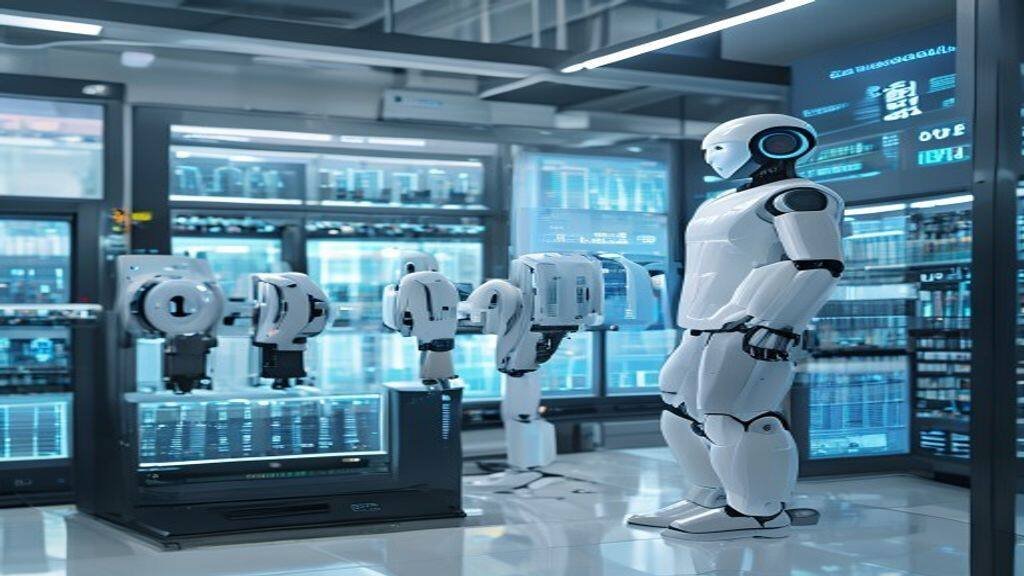
In a move that signals a seismic shift in global industrial strategy, the South Korean government has unveiled an ambitious, multi-decade economic roadmap. By pledging a staggering $1 trillion investment into the nation’s technological infrastructure, Seoul is positioning itself not merely as a participant in the global tech race, but as the primary architect of the next industrial revolution. The focus of this massive capital injection is twofold: cementing South Korea’s dominance in the high-bandwidth memory (HBM) chip market and accelerating the integration of humanoid robotics into the workforce. For a nation that has long relied on its semiconductor prowess to anchor its GDP, this pivot represents a calculated bet on the future of artificial intelligence and automated labor.
The Semiconductor Super-Cycle: Why Memory Matters
At the heart of this investment lies the critical need for memory architecture that can support the voracious appetite of modern generative AI. As large language models continue to expand in complexity, the traditional limitations of standard DRAM have become a bottleneck. South Korea’s leading chipmakers, Samsung Electronics and SK Hynix, are already at the forefront of the HBM market, but global competition from rivals in the United States and Taiwan is intensifying. The government’s $1 trillion commitment is designed to provide the necessary fiscal runway to build out “mega-clusters” of semiconductor fabrication plants.
These new facilities will focus on the next generation of 3D-stacked memory chips, which allow for faster data throughput and lower energy consumption—two non-negotiable requirements for training advanced AI. By subsidizing R&D costs and streamlining the regulatory hurdles for land acquisition and power supply, Seoul aims to create an ecosystem where the cost of production is significantly lower than that of its international peers. This is not just about manufacturing volume; it is about controlling the supply chain bottleneck that currently dictates the pace of AI progress worldwide.
The Rise of the Humanoid: Beyond the Factory Floor
While semiconductors provide the “brains” for the coming decade, the second pillar of South Korea’s strategy—humanoid robotics—provides the “body.” Historically, South Korea has been a leader in industrial automation, with one of the highest robot-to-human ratios in manufacturing globally. However, the new policy initiative aims to move beyond static, caged robotic arms. The government is pouring capital into the development of bipedal and multi-purpose humanoid robots capable of navigating unpredictable, human-centric environments.
The strategic logic here is rooted in demographics. South Korea faces one of the most severe aging population crises in the developed world, with a shrinking workforce threatening long-term economic stability. By investing in humanoids that can assist in elder care, logistics, and hazardous construction environments, the state hopes to mitigate the impact of labor shortages. Furthermore, the goal is to develop a domestic supply chain for robot components—sensors, actuators, and AI-driven control software—that can be exported globally, turning South Korea into a primary vendor for the international robotics market.
The Convergence of Hardware and AI
What makes this $1 trillion initiative particularly significant is the intentional convergence of these two sectors. A humanoid robot is essentially a mobile, real-time processor that requires high-performance memory chips to make split-second decisions. By developing both the underlying chip technology and the robotic chassis within the same national borders, South Korea is creating an integrated “tech stack” that is difficult for foreign competitors to replicate.
This vertical integration allows for a feedback loop: data gathered from humanoid deployments can be used to optimize the next generation of semiconductors, which in turn makes the robots faster and more efficient. It is a closed-loop innovation cycle that the South Korean Ministry of Science and ICT believes will provide a sustainable competitive advantage for at least the next twenty years. The government is also fostering partnerships between major conglomerates and agile startups, ensuring that the heavy lifting of manufacturing is supported by the rapid iteration of the software development community.
Economic Risks and Global Implications
Naturally, an investment of this scale carries significant risks. The semiconductor industry is notoriously cyclical, prone to sudden gluts and price crashes that can render massive capital expenditures temporarily unprofitable. Additionally, the humanoid robotics market is still in its infancy; while the potential is vast, the path to commercial viability for general-purpose humanoids remains unproven. Skeptics point out that pouring such vast sums into state-backed projects could potentially lead to inefficiencies or the misallocation of resources if the technological breakthroughs do not manifest on the expected timeline.
Furthermore, this move will undoubtedly draw scrutiny from international trade partners. As the U.S., EU, and China all scramble to protect their own “strategic autonomy” in tech, South Korea’s massive subsidies might trigger trade disputes. Yet, for Seoul, the choice is clear: in an era where technological sovereignty is synonymous with national security, the risk of inaction is far greater than the risk of aggressive investment.
Outlook: A New Era of Korean Tech
The coming decade will serve as the proving ground for South Korea’s bold vision. If successful, the country will transition from a hardware-centric manufacturing hub to an integrated leader in the AI-physical hybrid economy. As we look ahead, the success of this $1 trillion initiative will likely be measured not by the sheer number of chips produced or robots deployed, but by the country’s ability to seamlessly integrate these technologies into the daily lives of its citizens and the global supply chain. For the tech industry, all eyes remain on Seoul, as the nation attempts to build the future, one wafer and one actuator at a time.
Original reporting: source.