














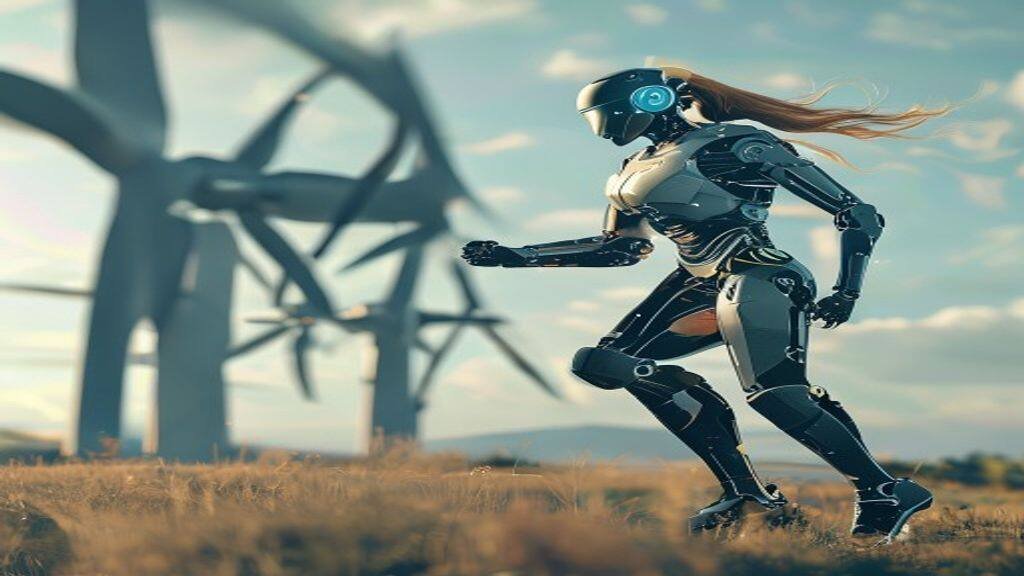
In the vast, shifting landscape of renewable energy, wind power has long been the backbone of the transition away from fossil fuels. However, the inherent unpredictability of wind—a force that changes direction and velocity in an instant—has historically capped the efficiency of massive turbine arrays. Today, a quiet revolution is taking place in the control rooms and sensor arrays of wind farms worldwide. Engineers and data scientists are no longer just building bigger blades or taller towers; they are teaching artificial intelligence to “run” with the turbines, transforming static infrastructure into a dynamic, learning ecosystem that anticipates the breeze before it even hits the rotor.
The Physics-Defying Complexity of Wind Farm Dynamics
To understand why AI is necessary, one must first grasp the complexity of a wind farm. A single turbine is a marvel of mechanical engineering, but in a farm setting, these machines become interdependent. When a turbine spins, it creates a “wake”—a turbulent zone of lower wind speed and higher turbulence that trails behind it. If a second turbine is positioned directly behind the first, it suffers from a significant drop in power generation and increased mechanical wear due to this wake effect.
Traditionally, wind farm controllers were reactive. They operated based on fixed parameters that assumed an idealized environment. If the wind speed changed, the turbines would adjust their pitch and yaw based on pre-programmed logic. However, these systems were essentially “blind” to the farm as a whole. Artificial intelligence changes this by introducing deep learning models capable of processing petabytes of sensor data in real-time. By analyzing historical wind patterns, atmospheric pressure, and the real-time telemetry of every turbine in a cluster, AI can predict the movement of wakes and adjust the orientation of individual turbines to minimize interference across the entire field.
Optimizing the “Wake Steering” Strategy
One of the most promising applications of AI in this sector is known as “wake steering.” Instead of forcing every turbine to face directly into the wind—a common practice that prioritizes individual performance at the expense of the collective—AI allows for a coordinated choreography. By intentionally misaligning the front-row turbines by a few degrees, the wake is deflected away from the turbines behind them. While the front turbine may lose a marginal amount of efficiency, the net gain for the downstream turbines is substantial.
Teaching an AI to manage this requires a sophisticated digital twin—a virtual, high-fidelity model of the wind farm that exists in the cloud. The AI runs thousands of simulations per second within this digital twin, testing different yaw angles and pitch adjustments against incoming wind gusts. When it finds the optimal configuration, it pushes those commands to the physical turbines. This process happens on a millisecond scale, far faster than any human operator could manage, effectively allowing the wind farm to “breathe” with the changing atmosphere.
Predictive Maintenance: Stopping Failures Before They Start
Beyond aerodynamic efficiency, AI is fundamentally changing the economics of wind energy through predictive maintenance. Wind turbines are notoriously difficult to service, often requiring specialized crews to climb hundreds of feet in the air or utilize expensive offshore vessels. When a gearbox fails or a blade develops a hairline fracture, the downtime can cost thousands of dollars in lost revenue per day.
By deploying machine learning algorithms that monitor vibration patterns, oil temperature, and acoustic signatures, operators can now identify the “fingerprint” of a failing component long before it breaks. These AI models learn to distinguish between the normal, rhythmic vibrations of a healthy turbine and the subtle, irregular tremors that signal mechanical fatigue. By shifting from a schedule-based maintenance model to an AI-driven, condition-based model, operators can schedule repairs during periods of low wind, ensuring that the turbines are running at full capacity when the wind is blowing strongest.
The Integration of Weather Forecasting and Grid Demand
The final piece of the puzzle is the integration of external data. Modern AI systems for wind energy don’t just look at the farm; they look at the grid. By incorporating hyper-local weather forecasting and real-time electricity market pricing, these AI systems can determine how much power to store, how much to feed into the grid, and how to position the turbines for maximum longevity versus maximum output.
In regions where energy prices fluctuate based on demand, AI can even prioritize the health of the hardware during low-price periods and push the hardware to its absolute limit during peak demand hours. This level of strategic decision-making turns a wind farm from a simple power generator into a smart, grid-responsive asset that helps stabilize the energy network rather than complicating it.
Outlook
The marriage of artificial intelligence and wind energy is moving beyond the pilot project phase and into global standard practice. As computational power continues to scale and sensor technology becomes more granular, we can expect wind farms to become increasingly autonomous. The future of wind energy lies in these “self-healing” and “self-optimizing” systems that require minimal human intervention. As we look toward a net-zero future, the ability to squeeze every possible kilowatt out of the air—not by building more, but by thinking smarter—will be the defining factor in the success of the global green energy transition.
Original reporting: source.