














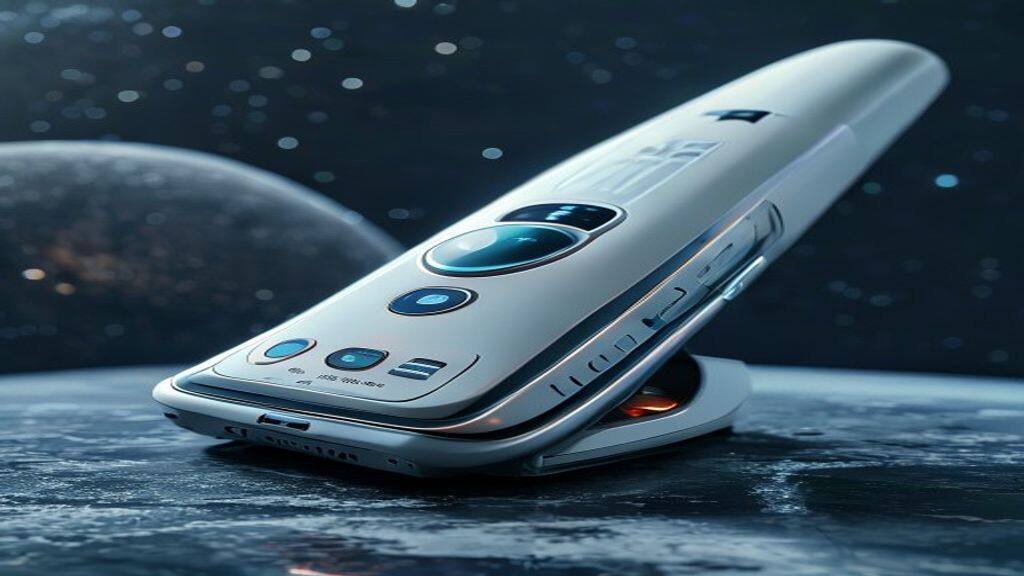
The boundary between traditional aerospace engineering and consumer-grade artificial intelligence is becoming increasingly porous. While SpaceX is primarily recognized for its reusable Falcon 9 rockets and the ambitious Starship program, recent regulatory filings and industry rumblings suggest that Elon Musk’s aerospace giant is quietly venturing into the hardware space with a device that feels suspiciously like a smartphone. This project, currently shrouded in technical jargon and patent secrecy, points toward a future where satellite connectivity and edge-based AI converge into a single, pocket-sized interface.
The Regulatory Breadcrumbs: Unveiling the Prototype
In the world of technology journalism, we often look to the Federal Communications Commission (FCC) as the ultimate arbiter of truth regarding unannounced hardware. Recent filings submitted by SpaceX have caught the attention of analysts who monitor the company’s expansion beyond satellite broadband. While SpaceX has historically focused on the Starlink user terminal—the familiar “Dishy” that connects residential homes to the constellation—the new documentation describes a piece of hardware that is significantly more compact, portable, and, crucially, equipped with localized processing capabilities.
The device in question is described as a handheld transceiver, but its internal architecture suggests it is far more than a simple walkie-talkie or a satellite phone. Industry experts point to the inclusion of specialized neural processing units (NPUs) within the hardware’s schematic. If SpaceX is integrating dedicated AI silicon into a portable device, it suggests that the company is aiming to reduce latency by performing data analysis directly on the device rather than offloading every query to a remote server. This is the hallmark of “edge AI,” a technology vital for users operating in remote areas where cloud-based communication might be intermittent.
Convergence of Starlink and Edge Intelligence
The strategic logic behind a “SpaceX phone” becomes clear when you consider the company’s ultimate goal: universal global connectivity. Currently, Starlink users require a bulky dish and a power-hungry router to tap into the satellite network. By developing a handheld device that utilizes the Direct-to-Cell capabilities SpaceX has been testing with T-Mobile, the company could bypass the need for ground-based infrastructure entirely.
However, satellite data speeds are inherently limited by the physics of long-distance transmission. This is where the AI prototype comes into play. By embedding an AI model directly into the device, SpaceX could theoretically optimize data usage, compress high-bandwidth requests locally, and provide intelligent assistance even when the connection to the satellite constellation is throttled. Imagine a device that understands the user’s intent and pre-fetches data or performs complex tasks locally, ensuring that the limited satellite bandwidth is reserved only for the most critical information packets.
Hardware Design: The “Phone-ish” Form Factor
Why would an aerospace company enter the crowded and highly competitive smartphone market? The answer may lie in the limitations of current mobile hardware. Most modern smartphones are designed for 5G cellular towers, not the high-altitude, high-velocity environment of low-Earth orbit (LEO) satellites. A device designed by SpaceX would likely prioritize antenna gain, thermal management for high-speed data bursts, and a battery architecture capable of maintaining consistent power output in extreme environmental conditions.
Reports indicate that the prototype features a ruggedized chassis, suggesting it is aimed at the “prosumer” market—explorers, emergency responders, and researchers working in the world’s most isolated regions. The interface, as described in preliminary leaks, relies heavily on voice-to-text and intent-based navigation, effectively removing the need for a traditional, fragile touch-screen display that might fail in extreme cold or heat. It is a “phone” in the sense that it facilitates communication, but its design philosophy is rooted in survival and extreme utility rather than social media consumption.
The AI Integration: A New Paradigm for Offline Computing
The most compelling aspect of this prototype is its reliance on localized AI. For SpaceX, the challenge has always been the “last mile” of connectivity. If the company can deploy a device that acts as an intelligent agent, it changes the value proposition of the Starlink network. Instead of just providing a pipe for the internet, SpaceX would be providing a complete, self-contained computing ecosystem.
This AI-first approach allows for sophisticated features such as real-time language translation without an internet connection, autonomous navigation assistance via satellite-linked GPS, and predictive maintenance alerts for the device itself. By keeping the AI local, SpaceX avoids the privacy concerns associated with cloud-based processing and ensures the device remains functional even in the most remote corners of the globe, from the middle of the Pacific Ocean to the high peaks of the Himalayas.
Outlook: A Disruptive Future
As we look toward the next eighteen months, the tech industry should keep a close watch on SpaceX’s hardware division. While it is unlikely that Elon Musk intends to go head-to-head with Apple or Samsung for the average urban consumer, the creation of an AI-integrated satellite transceiver represents a significant shift in the company’s roadmap. If successful, this device could redefine what it means to be “connected,” effectively rendering traditional cellular dead zones a relic of the past. SpaceX is not just building a phone; they are building a universal terminal for the next era of human exploration, backed by the silent, local power of artificial intelligence.
Original reporting: source.