












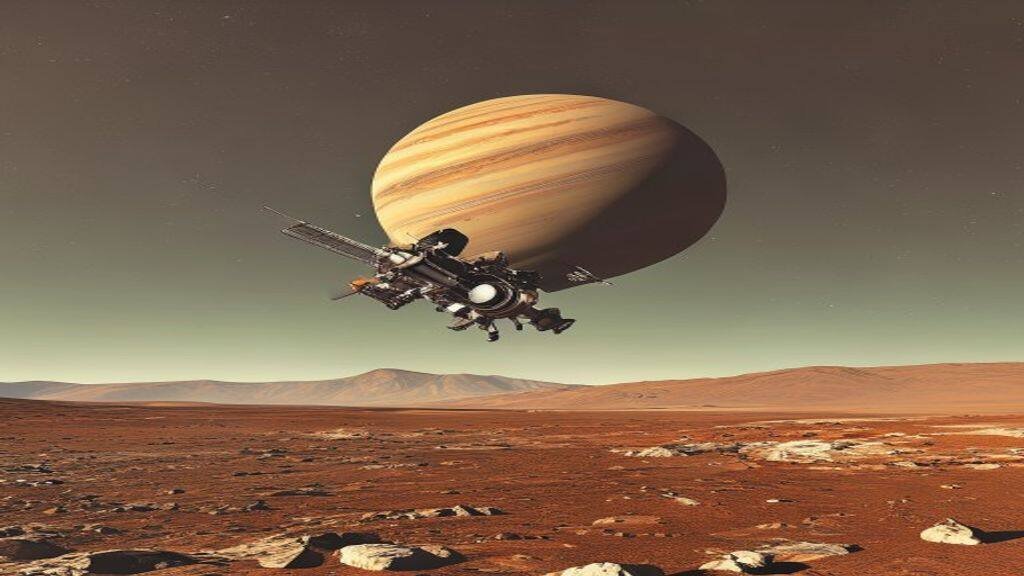
In the vast, silent expanse of our solar system, the journey of NASA’s Psyche spacecraft has served as a testament to both human ingenuity and the relentless pursuit of cosmic knowledge. While the mission’s ultimate destination remains the metallic asteroid 16 Psyche—a unique world orbiting between Mars and Jupiter—the spacecraft recently provided us with a breathtaking perspective of our own planetary neighborhood. As Psyche performed a critical gravity-assist maneuver, it captured a series of images that NASA has transformed into a stunning timelapse of the Red Planet, offering a rare, high-definition look at Mars from the vantage point of a deep-space explorer.
Engineering Precision in the Void
The Psyche mission, launched in October 2023, is not merely a voyage to a distant rock; it is a complex feat of orbital mechanics. To reach its namesake asteroid, the spacecraft must utilize a gravity-assist maneuver, a technique where a spacecraft swings past a planet to gain velocity or alter its trajectory without consuming precious onboard propellant. In May 2026, Psyche completed this maneuver around Mars, utilizing the planet’s gravitational pull to slingshot itself toward the outer reaches of the asteroid belt.
During this high-stakes encounter, the spacecraft’s onboard cameras were activated to conduct routine check-ups and navigation calibrations. However, the resulting data yielded something far more evocative than simple telemetry. The timelapse released by NASA showcases Mars as a shrinking sphere against the backdrop of the star-dusted vacuum, providing a humbling reminder of the scale of our solar system. The footage captures the planet rotating, with its distinct albedo features—the dark volcanic plains and the lighter, dusty highlands—becoming increasingly sharp as the spacecraft approached its point of closest proximity.
The Technology Behind the Lens
From a gadget and hardware perspective, the imagers aboard Psyche represent a significant step forward in space-hardened optical technology. The spacecraft is equipped with a dual-camera system, designed to provide high-resolution navigation and scientific imaging. These cameras are engineered to withstand the extreme temperature fluctuations of deep space, oscillating between the intense solar radiation of the inner solar system and the frigid shadows of the asteroid belt.
The imagers use high-sensitivity sensors capable of capturing images in both visible and near-infrared spectra. This hardware is critical for the mission’s primary objective: mapping the surface of 16 Psyche. Because the asteroid is believed to be the exposed nickel-iron core of an early protoplanet, the cameras must be able to discern subtle geological textures and mineral compositions. The Mars timelapse served as an excellent “field test” for these systems, proving that the optical instruments are performing well within their operational parameters long before they reach the main mission target.
Why Mars Matters to Psyche
While the focus of the mission is the asteroid, the Mars flyby provided a unique opportunity for scientists to calibrate their instruments using a known reference point. By imaging a planet with a well-documented atmosphere and surface, researchers can fine-tune the image processing pipelines that will eventually be used to analyze the cratered and metallic landscape of 16 Psyche. This ensures that when the spacecraft finally arrives at its destination in 2029, the data transmitted back to Earth will be of the highest possible fidelity.
Furthermore, the timelapse highlights the evolution of deep-space communication. As Psyche moves further away, the latency between Earth and the spacecraft increases, and the data transmission rates drop. The successful capture and downlink of this high-definition timelapse demonstrate that the Deep Space Network (DSN) and the spacecraft’s communication suite are operating in perfect harmony. It is a technological triumph that allows us to witness the solar system in real-time, even when the subject is millions of miles away.
The Broader Implications for Space Exploration
This mission is part of a growing trend in space exploration where the “journey” is just as important as the destination. By leveraging gravity assists, NASA is able to send heavier, more sophisticated payloads into deep space with less fuel, effectively extending the lifespan of these missions. The hardware onboard Psyche—from its solar-electric propulsion system to its advanced imaging arrays—represents the current state-of-the-art in aerospace engineering.
As we watch the mesmerizing timelapse of Mars, it is impossible not to reflect on the gadgets we carry in our pockets. Our smartphones and high-end digital cameras rely on similar sensor technologies, yet the versions mounted on Psyche are built to endure radiation environments that would fry commercial electronics in minutes. This mission serves as an ongoing R&D project for the next generation of deep-space hardware, pushing the boundaries of what is possible in terms of size, weight, and power efficiency.
Outlook: A Long Road to the Metal World
As the Psyche spacecraft continues its trajectory toward the asteroid belt, the Mars timelapse serves as a beautiful, fleeting memory of the inner solar system. The spacecraft is now well on its way, with its ion thrusters providing a steady, gentle push that will see it arrive at 16 Psyche in late 2029. In the coming years, we can expect more such glimpses of the cosmos, as the probe continues to test its systems and prepare for the ultimate study of a world that may hold the secrets to the formation of our planetary neighborhood. For now, the Mars footage stands as a triumph of both engineering and artistry, reminding us that even in the cold, mechanical process of space travel, there is profound beauty to be found.
Original reporting: source.