


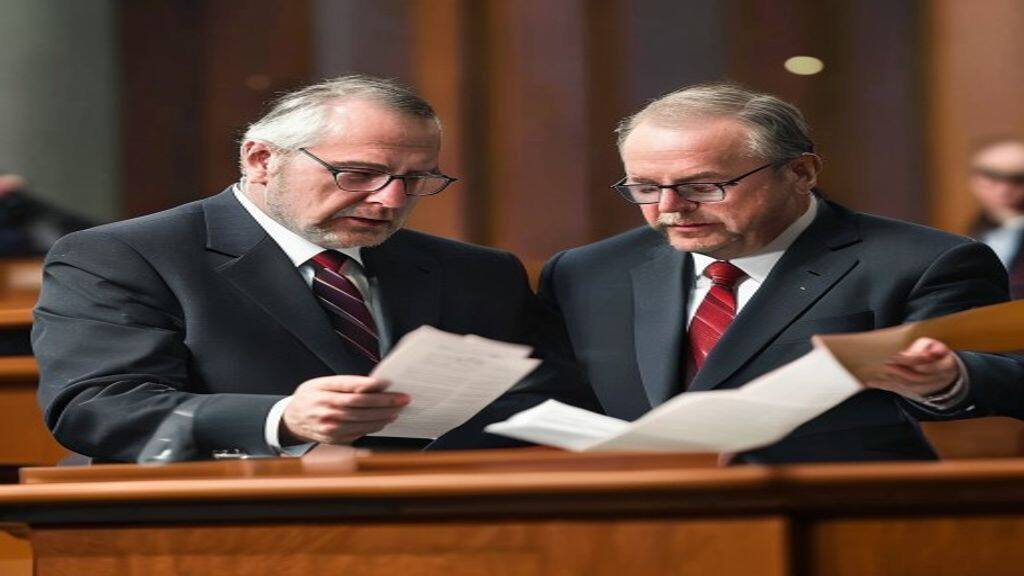
In a surreal convergence of governance and artificial intelligence, the hallowed halls of the Canadian Parliament recently played host to a moment that felt ripped from the pages of a high-tech satire. During a floor speech, a Canadian legislator utilized text generated by a Large Language Model (LLM) to articulate points on the legislative floor, sparking a firestorm of debate regarding the future of political discourse, the integrity of parliamentary tradition, and the creeping influence of silicon-based cognition in our democratic institutions. While the use of drafting software is nothing new in the world of politics, the blatant reliance on an automated generative model to formulate an entire argument raises significant questions about the authenticity of the voices we elect to represent us.
The Incident: When Algorithms Take the Podium
The incident unfolded during a routine session, catching many observers off guard. As the legislator began their remarks, the cadence and structure of the speech—often telltale signs of AI-generated content—became immediately apparent to those familiar with the stylistic fingerprints of models like ChatGPT or Claude. The prose was impeccably smooth, devoid of the idiosyncratic flourishes, rhetorical stumbles, or passionate vernacular that typically characterize spontaneous political debate. Instead, the audience was presented with a polished, balanced, and strangely hollow summary of the issue at hand.
Critics were quick to point out that the speech lacked the “human touch”—the lived experience and nuanced emotional stakes that should underpin legislative advocacy. By outsourcing the drafting process to an LLM, the representative effectively bypassed the rigorous cognitive process of synthesizing a personal stance. The debate quickly shifted from the content of the speech to the process of its creation, forcing a confrontation between efficiency and accountability. If a legislator can press a button and generate a coherent argument on a complex issue without fully engaging with its intricacies, what does that mean for the quality of our legislation?
The Efficiency Paradox: Productivity vs. Authenticity
Proponents of using AI in political offices argue that the sheer volume of legislative work is overwhelming. Modern politicians are expected to be experts on everything from environmental policy and international trade to healthcare reform and local zoning laws. In this context, LLMs can be viewed as sophisticated research assistants, capable of summarizing vast amounts of data and drafting foundational documents in seconds. For a staffer or an overworked representative, the temptation to use these tools to clear a backlog of paperwork or draft routine press releases is immense.
However, there is a fundamental difference between using an AI to organize a calendar and using it to formulate the core arguments of a parliamentary speech. A speech is a performance of values; it is an act of persuasion that relies on the speaker’s perceived credibility. When the public realizes that the words spoken in the chamber are merely the “most likely” sequence of words predicted by a statistical model, the contract of trust between the representative and the represented begins to fray. The efficiency gained by AI is arguably offset by the erosion of the personal connection that is the bedrock of representative democracy.
The Risks of Algorithmic Echo Chambers
Beyond the issue of authenticity, there is the technical concern of “hallucinations” and inherent bias. LLMs are trained on massive datasets that reflect the entirety of the internet—a repository of both human wisdom and human prejudice. When a legislator relies on an LLM to generate arguments, they are essentially outsourcing their rhetorical framework to a “black box” that prioritizes statistical probability over factual accuracy or moral clarity. If the model incorporates biased historical data or subtle inaccuracies, those errors are then amplified from the highest podium in the country.
Furthermore, there is the risk of intellectual stagnation. If political discourse becomes dominated by AI-generated talking points, we risk entering a feedback loop where the language of politics becomes increasingly generic and sanitized. Real political progress often comes from challenging the status quo, using creative metaphors, and appealing to shared human experiences—things that LLMs, by their nature, are designed to avoid in favor of the “middle-of-the-road” output. We risk a future where parliamentary debates become a contest of who has the most sophisticated prompt, rather than who has the most compelling vision for the country.
Setting the Standard: What Comes Next?
The Canadian incident is undoubtedly a harbinger of a broader trend. As generative AI becomes more integrated into professional workflows, every sector, from law to journalism and governance, will have to establish guardrails. Should there be a disclosure requirement? If a legislator uses AI to craft a speech, should it be mandatory to include a “Powered by AI” disclaimer, similar to how we label sponsored content or digitally altered imagery? Transparency is the only way to maintain public trust in an era where the line between human and machine creativity is becoming increasingly blurred.
Moving forward, the challenge for legislatures worldwide will be to define the ethical boundaries of AI usage. It is unlikely that we can—or even should—ban these tools entirely. They offer undeniable benefits in terms of accessibility and productivity. However, there is a clear distinction between using AI as a tool for research and using it as a substitute for the cognitive labor required of a public official. The Canadian parliament has found itself at the vanguard of this conversation, and the outcome of this debate will likely set a precedent for how other nations handle the automation of democracy.
Outlook
The integration of AI into political speechmaking is inevitable, but it must be managed with extreme caution. As we look ahead, we can expect to see the development of internal parliamentary codes of conduct that address AI transparency. While technology will continue to assist in the drafting of policy, the final responsibility for the words spoken in a legislative chamber must remain firmly in human hands. If we lose the ability to distinguish between a machine’s prediction and a human’s conviction, we lose the very essence of the debate that sustains a free society.
Original reporting: source.