














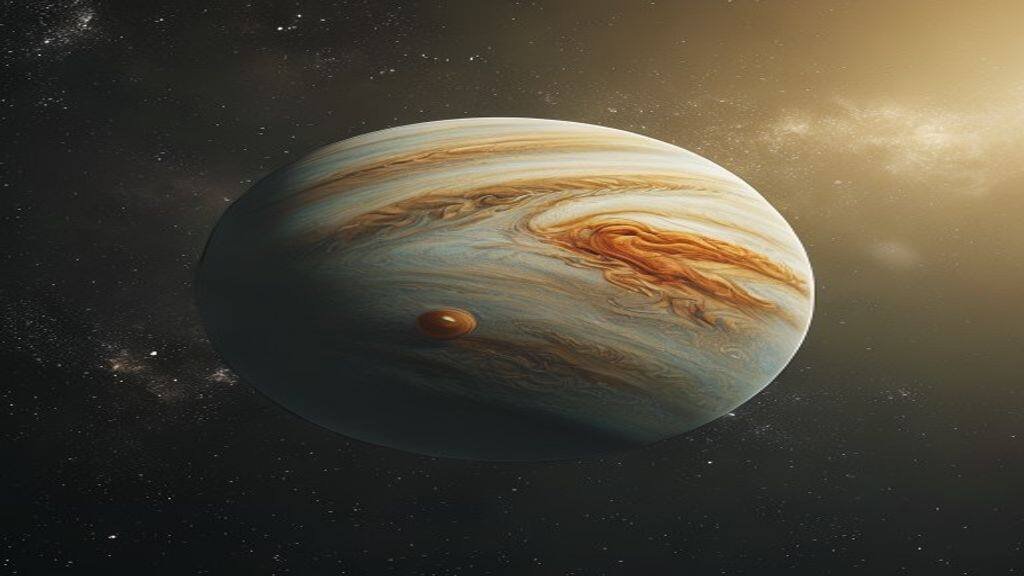
In the vast, often violent theater of cosmic evolution, stars are usually the protagonists, while planets are merely the supporting cast. We have long understood that when a star exhausts its nuclear fuel, it undergoes a dramatic transformation—often expanding into a bloated red giant that consumes anything in its immediate vicinity. However, a recent discovery published in the journal Nature has challenged our fundamental assumptions about the longevity of planetary systems. Astronomers have identified an exoplanet, roughly the size of Jupiter, that has somehow survived the catastrophic death of its host star. This celestial survivor, orbiting the remnants of a white dwarf, offers a rare glimpse into the potential fate of our own solar system billions of years from now.
The Anatomy of a Stellar Demise
To understand the significance of this discovery, one must first appreciate the typical life cycle of a Sun-like star. For the majority of their existence, these stars fuse hydrogen into helium, maintaining a delicate equilibrium between the inward pull of gravity and the outward pressure of nuclear fusion. Once the hydrogen is depleted, the star begins to burn helium, causing its outer layers to expand dramatically. In this red giant phase, the star can swell to hundreds of times its original size, effectively engulfing any nearby orbiting planets.
Most planetary systems are not expected to survive this transition. The inner planets, like Mercury, Venus, and potentially Earth, are likely to be swallowed by the expanding stellar envelope. The friction caused by moving through this diffuse, gaseous outer layer would cause their orbits to decay, spiraling them into the star’s core. The fact that a Jupiter-sized gas giant has been found orbiting a white dwarf—the dense, cooling core left behind after the red giant sheds its outer layers—suggests that our current models of planetary survival are incomplete.
A Survivor in the Stellar Graveyard
The system in question, located thousands of light-years away, features a white dwarf that was once a main-sequence star, similar to our Sun. The exoplanet, designated as a gas giant, maintains an orbit that places it far enough from the white dwarf to have avoided complete destruction. Researchers utilized high-resolution imaging and gravitational microlensing to confirm the planet’s existence and its distance from the stellar core.
What makes this finding particularly compelling is the planet’s orbital distance. It resides in a position that would have been well within the radius of its star during the red giant phase. This implies that the planet either migrated outward as the star lost mass—a phenomenon known as adiabatic orbit expansion—or that it was pushed into a wider, safer orbit by the complex gravitational dynamics of the system as the star shed its outer layers. This “escape” provides a rare empirical data point for astrophysicists trying to map the chaotic transition period between a star’s death and its final state as a white dwarf.
Implications for the Earth’s Future
While the discovery is a triumph of observational astronomy, it also serves as a poignant reminder of the eventual fate of our own neighborhood. The Sun is expected to enter its red giant phase in approximately five billion years. While the inner rocky planets are almost certainly doomed, the long-term prospects for the outer gas giants, Jupiter and Saturn, remain a subject of intense debate.
This newly discovered system acts as a “ghost of the future.” By studying the chemical composition of the white dwarf’s atmosphere and the orbital characteristics of the surviving planet, scientists can infer how mass loss affects planetary migration. If a Jupiter-sized planet can survive the violent shedding of a star’s atmosphere, it suggests that the architecture of planetary systems is more resilient than previously thought. It raises the possibility that even after the Sun dies, the outer reaches of the solar system may remain populated by its existing gas giants, orbiting a cold, dim white dwarf.
Technological Challenges and Future Observations
Identifying such systems is no small feat. White dwarfs are incredibly faint, and detecting an exoplanet orbiting them requires a combination of precise photometry and long-term monitoring. The team behind this study relied on data from ground-based observatories and space-based telescopes to filter out the noise of the galaxy. The process is akin to finding a single firefly hovering next to a distant, dim lighthouse.
Moving forward, the scientific community is looking toward the next generation of observatories. With the increased sensitivity of the James Webb Space Telescope (JWST) and the upcoming Nancy Grace Roman Space Telescope, researchers hope to conduct a census of white dwarf systems. If this survivor is not an anomaly but rather a common occurrence, it would mean that the “death” of a star is not necessarily the end of its planetary system, but rather a radical reconfiguration.
Outlook: A New Chapter in Exoplanetary Science
The discovery of this Jupiter-sized survivor marks a paradigm shift in how we perceive the longevity of planetary systems. It moves us away from a strictly catastrophic view of stellar evolution and toward a more nuanced understanding of orbital mechanics during mass-loss events. As we continue to scan the heavens, each new survivor discovered helps us fill in the blanks of our cosmic history. We are no longer just looking for planets that might harbor life; we are beginning to catalog the resilience of the universe itself, proving that even in the face of total stellar collapse, some remnants of a system can endure, drifting silently through the dark, cold expanse of the afterlife.
Original reporting: source.