














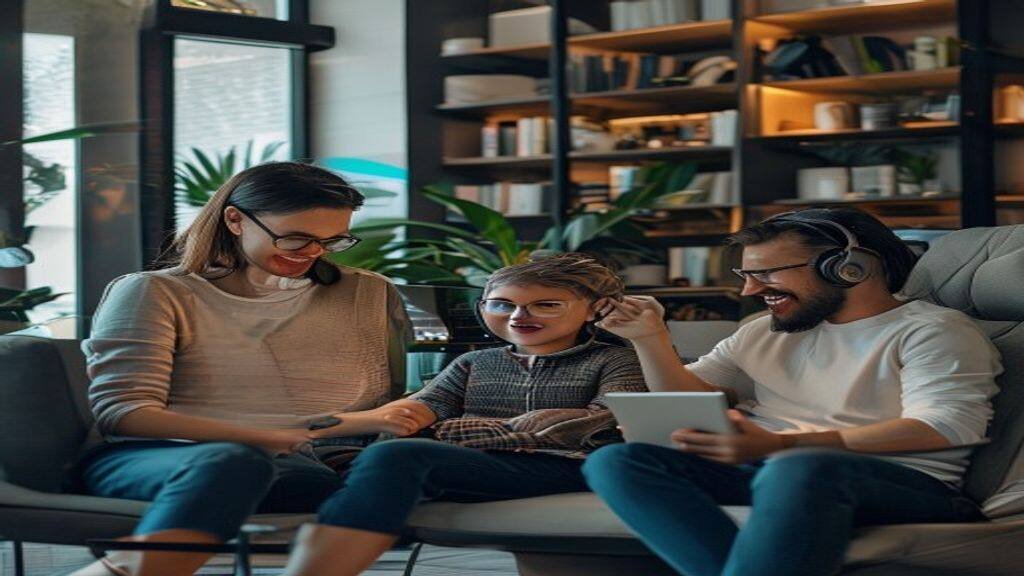
For the past two years, OpenAI has primarily occupied the desks of software developers, the screens of content creators, and the boardrooms of enterprise giants. However, a significant pivot is underway. As artificial intelligence matures from a novelty into a utility, OpenAI is aggressively targeting the domestic sphere, positioning ChatGPT not merely as a productivity tool for professionals, but as a central nervous system for the modern family unit. This strategic shift marks a transition from “AI for work” to “AI for life,” raising questions about how our household dynamics—and our reliance on technology—will evolve in the coming years.
The Domestic Transformation: Beyond the Search Engine
The traditional family computer has long been a gateway to information, but OpenAI envisions a future where ChatGPT functions as an active participant in household management. Recent updates to the platform, including enhanced voice capabilities, real-time vision, and the rollout of “Memory” features, are tailored to solve the friction points of daily life. For a busy parent, this means moving beyond simple search queries to complex orchestration. Instead of looking up recipes, parents are increasingly using ChatGPT to generate meal plans based on the specific dietary restrictions of their children and the remaining contents of their refrigerator.
This movement is supported by the integration of AI into mobile ecosystems. By making ChatGPT a primary interface on smartphones, OpenAI has lowered the barrier to entry for family members who may not be tech-savvy. Whether it is explaining complex homework concepts to a middle-schooler, drafting permission slips for field trips, or organizing a family vacation itinerary, the tool is being reframed as a collaborative partner. By reducing the “cognitive load” of household administration, OpenAI is betting that families will integrate the service into their daily routines as naturally as they once integrated the television or the microwave.
Personalization and the “Memory” Advantage
The most critical component of OpenAI’s family-centric strategy is the evolution of persistent memory. In the early days of generative AI, every conversation was a blank slate, requiring users to repeat context. The current iteration of ChatGPT can now retain information across sessions—remembering that a family prefers vegetarian dinners, that a toddler is currently obsessed with space exploration, or that a student struggles with specific algebraic concepts. This longitudinal data creates a personalized experience that feels less like a database and more like a digital assistant that knows the family’s history.
This personalization, however, brings the issue of data privacy to the forefront. As families feed more personal details into the model—schedules, preferences, and private discussions—the responsibility on OpenAI to maintain robust security becomes paramount. The company has introduced enterprise-grade controls for personal accounts, allowing users to opt out of training on their data, but the challenge remains in educating the average household on how to manage these privacy settings. For widespread adoption, OpenAI must prove that the convenience of a “smart” family assistant does not come at the cost of personal data security.
The Education Gap and Intergenerational AI
One of the most significant impacts of OpenAI’s push into the home is the democratization of private tutoring. For decades, high-quality, personalized supplemental education was a luxury reserved for those who could afford private tutors. ChatGPT is rapidly leveling this playing field. By serving as an on-demand tutor that can explain a concept in five different ways—or translate it into a different language—the AI is becoming a fixture in the lives of students.
This has also sparked a shift in intergenerational dynamics. We are seeing a trend where younger generations, who are more digitally native, introduce these tools to their parents and grandparents. This “reverse mentoring” creates a unique dynamic where the AI serves as a bridge for communication and shared activity. Whether it is helping a grandparent draft emails or assisting a child with creative writing, the tool is increasingly becoming a shared family asset rather than an individual toy.
The Challenges of Integration
Despite the optimism, the path to the “AI-powered home” is not without obstacles. Critics argue that over-reliance on generative AI for daily problem-solving could lead to a degradation of traditional skills, such as planning, critical thinking, and independent research. If a machine handles the logistics of a family schedule or the nuances of drafting a letter, does the human capacity for those tasks atrophy? Furthermore, there is the social implication of “screen time.” As AI becomes more conversational and engaging, the risk of digital isolation within the home environment is a concern that psychologists and educators are beginning to monitor closely.
OpenAI’s challenge is to balance the utility of the tool with the need for human-centric interaction. The company has signaled an interest in “multimodal” experiences, moving away from text-heavy interfaces toward more natural, conversational voice interactions. This shift aims to make the AI feel more like a presence in the room, but it also necessitates a new set of digital etiquette standards for families to adopt.
Outlook: A New Household Norm
Looking ahead, the integration of ChatGPT into the family unit appears inevitable. As OpenAI continues to refine its models to be more helpful, safer, and more deeply integrated into the operating systems we use every day, the distinction between “using software” and “collaborating with AI” will continue to blur. In the near term, we expect to see more specialized features—perhaps family-shared accounts or child-safe modes—designed specifically to accommodate the diverse needs of a household. Ultimately, if OpenAI can successfully navigate the complexities of privacy and digital well-being, ChatGPT is poised to become the most significant addition to the modern home since the advent of high-speed internet.
Original reporting: source.